Introduction: Performance Should Be Measurable
Training should produce results.
Not guesses.
Not vibes.
Not “it feels better.”
At Nomadic Performance, we use objective testing to evaluate whether programming truly improves athletic capacity.
This 12-week training cycle assessed 13 athletes across six performance domains:
- Explosive power
- Unilateral power
- Limb symmetry
- Frontal plane endurance
- Core stability
- Dynamic balance
What follows is a full breakdown of the results.
📊 Study Overview
- Participants: 13 Athletes
- Duration: 12 Weeks
- Population: Recreational to Competitive Mountain Athletes
- Testing Battery:
- Broad Jump
- Single Leg Triple Hop
- Triple Hop Symmetry
- 30-Second Lateral Step Down
- 30-Second Side Plank + Hip Abduction
- Anterior Reach Y-Balance
🚀 Explosive Power
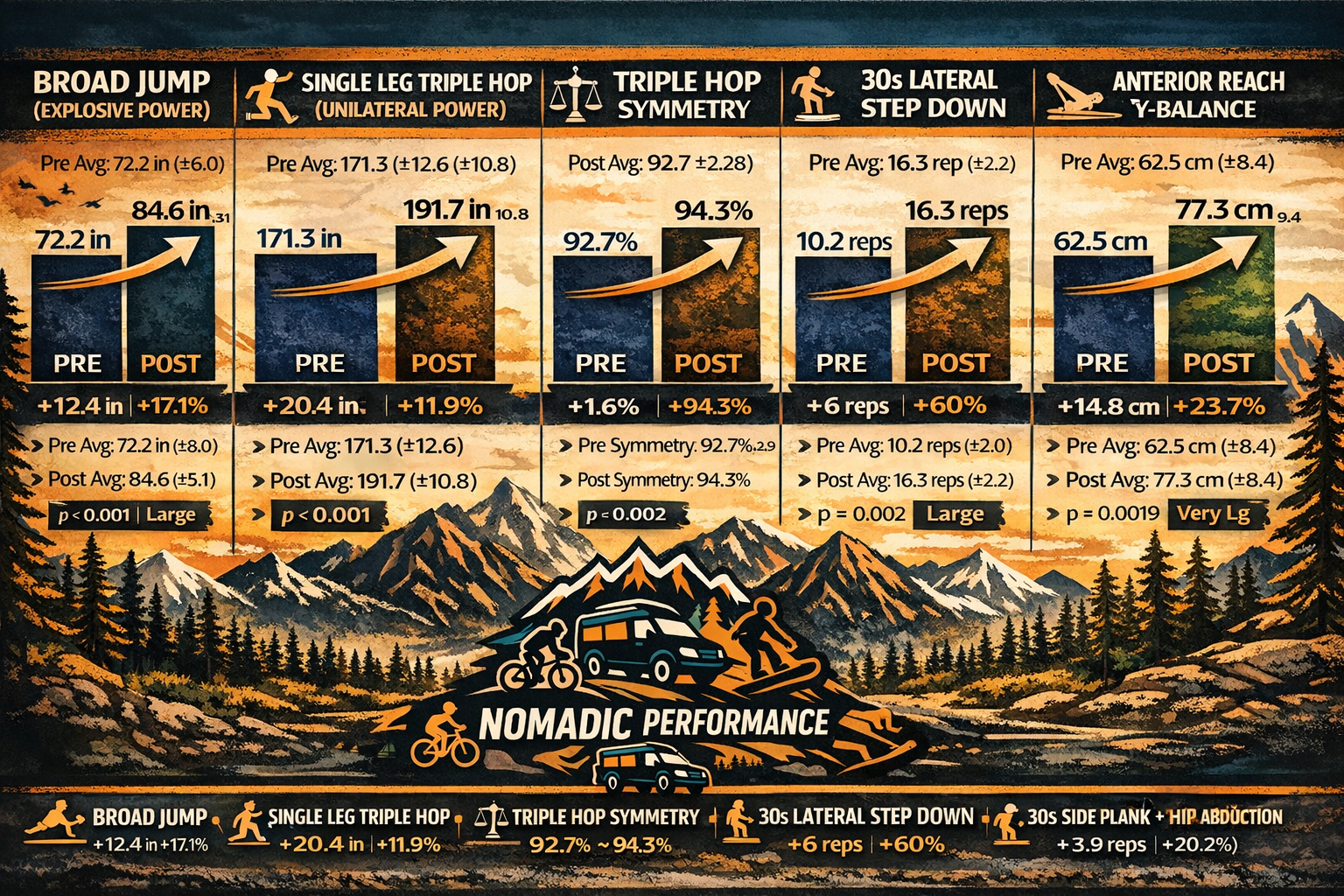
Broad Jump
Pre Avg: 72.7 inches
Post Avg: 86.2 inches
+13.4 inches improvement
+18.5% increase
p < 0.001 (Highly Significant)
This represents a substantial increase in lower-body power production.
Power improved without sacrificing control — a critical component for skiing, snowboarding, trail running, and climbing.
🦵 Unilateral Power
Single Leg Triple Hop
Pre Avg: 174.9 inches
Post Avg: 191.1 inches
+16.2 inches improvement
+9.2% increase
This demonstrates improved:
- Single-leg force production
- Landing control
- Reactive stability
In unilateral sports environments, this is highly meaningful.
⚖️ Symmetry Control
Triple Hop Symmetry
Pre Symmetry: 92.7%
Post Symmetry: 93.7%
Symmetry was maintained while power improved.
That matters.
Performance gains without asymmetry development reflect healthy adaptation — not compensation.
🧱 Frontal Plane Endurance
30-Second Lateral Step Down
Pre Avg: 9.6 reps
Post Avg: 16.2 reps
+6.6 reps improvement
+68% increase
Large Effect Size
This was one of the most dramatic improvements.
Frontal plane endurance is strongly associated with:
- Knee control
- Valgus resistance
- Injury risk reduction
This result indicates meaningful increases in lower-extremity durability.
🧠 Core Stability
30-Second Side Plank + Hip Abduction
Pre Avg: 19.2 reps
Post Avg: 23.1 reps
+3.9 reps improvement
+20.2% increase
p = 0.021 (Statistically Significant)
This reflects improvements in:
- Glute med endurance
- Pelvic control
- Lateral trunk stabilization
Core endurance improved without increasing asymmetry.
⚖️ Dynamic Balance & Mobility
Anterior Reach Y-Balance
Pre Avg: 62.5 cm
Post Avg: 77.3 cm
+14.8 cm improvement
+23.7% increase
p = 0.0019
Very Large Effect Size (d = 1.10)
This was one of the strongest statistical findings.
Dynamic balance improved dramatically, indicating enhanced:
- Ankle mobility
- Single-leg stability
- Neuromuscular control
- Proprioceptive capacity
📈 Multi-System Adaptation
| Domain | Result |
|---|---|
| Explosive Power | ↑ Significant |
| Unilateral Strength | ↑ Meaningful |
| Symmetry | Maintained |
| Frontal Endurance | ↑ Dramatic |
| Core Stability | ↑ Significant |
| Dynamic Balance | ↑ Very Large Effect |
This is not isolated strength gain.
It is system-wide adaptation.
🧠 Why This Matters
Performance isn’t built in one dimension.
True durability requires:
- Power
- Stability
- Endurance
- Symmetry
- Mobility
- Control
This training cycle improved all six.
That suggests programming was:
- Appropriately dosed
- Progressively overloaded
- Movement-focused
- Stability-integrated
- Injury-conscious
🔬 The Role of Testing
Testing is not about proving that athletes improved.
It’s about refining future programming.
These results provide actionable coaching insight:
- Frontal plane endurance responds rapidly to targeted loading.
- Mobility and stability can improve simultaneously.
- Power can increase without sacrificing symmetry.
- Core endurance benefits from integrated lower-body programming.
As a coach, this data helps me evolve the system.
Each training cycle becomes more precise than the last.
🏔 The Nomadic Performance Standard
Most programs focus on aesthetics or arbitrary intensity.
We focus on:
✔ Measurable improvement
✔ Injury resilience
✔ Movement quality
✔ Longevity
✔ Objective data
This 12-week outcomes report reflects what happens when programming is structured and intentional.
🎯 What This Means for You
If you’re an athlete who wants:
- Fewer injuries
- Stronger turns
- Better landings
- More trail control
- Greater confidence under fatigue
Then training should be assessed, not assumed.
🏁 Final Thoughts
In 12 weeks, athletes demonstrated:
- Nearly 20% improvement in power
- 60%+ improvement in frontal endurance
- 20% improvement in core stability
- 24% improvement in dynamic balance
And they did it while maintaining symmetry.
That’s not luck.
That’s structure.
That’s assessment-driven performance.
Move Free. Thrive Wild.