The Frustration of the Repeat Injury
You finally start feeling good again. Your back's calm, your knee feels solid, your shoulder's behaving. You ease back into workouts, the trail, or the mountain — and then… it happens again.
The same nagging pain. The same movement that "tweaks" it. The same setback.
If this sounds familiar, you're not alone. Recurring injuries are one of the most common frustrations I see as a physical therapist and strength coach — and the good news is, there's always a reason behind them.
Reason #1: You Treated the Symptoms, Not the Source
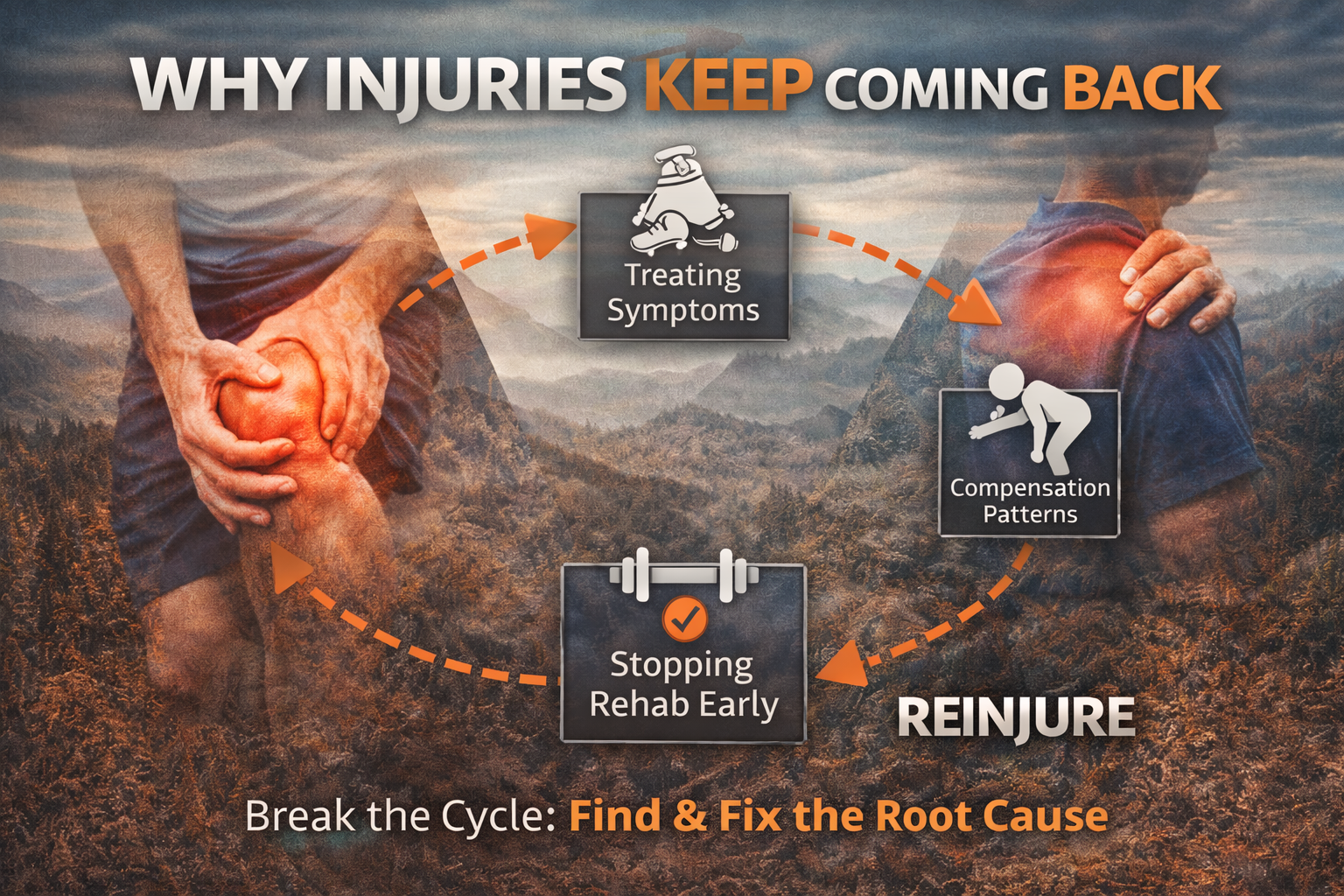
When most people get hurt, the focus is on where it hurts, not why it hurts.
You rest, ice, stretch, or get a quick massage. Maybe you even do a few exercises from the internet. The pain fades — but the root cause is still there.
Here's the truth:
The body rarely breaks down where the problem starts — it breaks down where the compensation ends.
A sore knee might come from poor hip control. Shoulder impingement might trace back to limited thoracic mobility. Lower back pain might stem from weak glutes or poor breathing mechanics.
Until you identify and fix the true driver, the pain will keep returning, no matter how many times you "rehab" the symptoms.
Reason #2: You Stopped Rehab Too Soon
Pain relief doesn't equal full recovery.
Many athletes stop doing their rehab the moment they feel better — but tissue healing, neuromuscular retraining, and load tolerance take much longer than pain resolution.
When you jump back into your full workload before your body is truly ready, you're essentially reloading the same weak link that wasn't fully reinforced.
Think of it like patching a tire without letting the glue set — it holds for a while, but eventually gives out under pressure.
Reason #3: You Never Addressed Movement Quality
Movement is a skill — and like any skill, it needs to be practiced correctly.
If your form, mobility, or motor control weren't ideal before the injury, and you go right back to moving the same way after, your body will keep using the same flawed pattern that caused the problem.
That's why part of every good rehab and performance plan should include:
- Movement retraining: Teaching your body to move efficiently again.
- Mobility restoration: Regaining range of motion without compensation.
- Strength symmetry: Ensuring both sides of your body share the load evenly.
Good movement is the best long-term injury insurance you can invest in.
Reason #4: You're Only Strong in One Direction
We train what we like — and often avoid what we need.
Most athletes overdevelop their dominant patterns (think: forward motion, pressing, or flexion) while neglecting stabilizers and opposing movement planes.
The result? Imbalances, poor load distribution, and repetitive stress in the same tissues.
For example:
- Runners often ignore hip abduction and rotation strength.
- Climbers neglect scapular control and trunk endurance.
- Skiers skip lateral stability and rotational strength.
When one system overpowers another, your body compensates — and that's where breakdowns happen.
Reason #5: You Never Rebuilt Your Capacity
Maybe your pain went away, your strength returned, and your mobility looked good — but you never rebuilt your tolerance.
Every sport has unique demands: impact forces, speed, endurance, reaction time, balance. If your tissues aren't progressively loaded to handle those forces again, you'll plateau below your real capacity — and risk re-injury as soon as you push harder.
Recovery isn't just about feeling "normal." It's about restoring the ability to perform at full intensity without fear.
How to Finally Break the Injury Cycle
Here's what separates those who stay healthy from those who keep getting hurt:
- Identify the root cause, not just the pain. Get a thorough movement assessment — not a generic diagnosis.
- Restore, then reinforce. Regain mobility, build control, then load it progressively.
- Train smarter, not just harder. Add variety. Challenge your body in all planes of motion.
- Respect recovery. Sleep, nutrition, hydration, and stress management matter as much as exercise.
- Stay proactive. Maintenance work isn't punishment — it's prevention.
The Nomadic Performance Approach
At Nomadic Performance, we don't just treat pain — we teach people to move differently, build resilience, and prevent injuries before they start.
Whether you're a skier, climber, cyclist, or weekend warrior, our philosophy is simple:
Train for longevity, not just performance.
Through mobility screens, movement testing, and tailored strength programs, we help athletes rebuild from the inside out — stronger, smarter, and more durable than before.
Because the goal isn't just to heal. It's to stay healthy, keep exploring, and move freely for life.
Final Thoughts
Recurring injuries aren't bad luck — they're information. Your body is telling you something's off, and it's your job to listen before it shouts.
If you've been stuck in the cycle of pain and recovery, don't just take time off — take action. Assess, rebuild, and move with intention.
Because your next adventure deserves a body that's built to last.