Introduction: Balance Is More Than Standing Still
When most people think about balance, they imagine standing on one leg without falling over.
But athletic balance is far more complex.
In real sport environments — skiing steep terrain, navigating uneven trails, landing jumps, or changing direction — athletes must control their body while moving dynamically over a single limb.
This ability is known as dynamic balance, and one of the most reliable ways to measure it is the Anterior Reach Y-Balance Test.
At Nomadic Performance, we use this test to evaluate how mobility, strength, and neuromuscular control work together. This case study examines how a structured 12-week training program influenced these qualities in a group of athletes.
Why the Anterior Reach Y-Balance Test?
The anterior reach component of the Y-Balance Test assesses how far an athlete can reach forward with one leg while maintaining control on the stance leg.
It reflects a combination of:
- Ankle dorsiflexion mobility
- Hip stability
- Core control
- Proprioception
- Single-leg balance
- Neuromuscular coordination
Research has shown that poor Y-Balance performance is associated with increased injury risk, particularly in lower-extremity sports.
In short:
The farther an athlete can reach while staying stable, the better their movement control tends to be.
Study Overview
- Participants: 13 athletes
- Training Duration: 12 weeks
- Assessment: Anterior Reach Y-Balance Test (cm)
Athletes completed bilateral testing before and after training. Left and right measurements were averaged for analysis.
Results
📊 Group Performance
| Metric | Pre-Training | Post-Training |
|---|---|---|
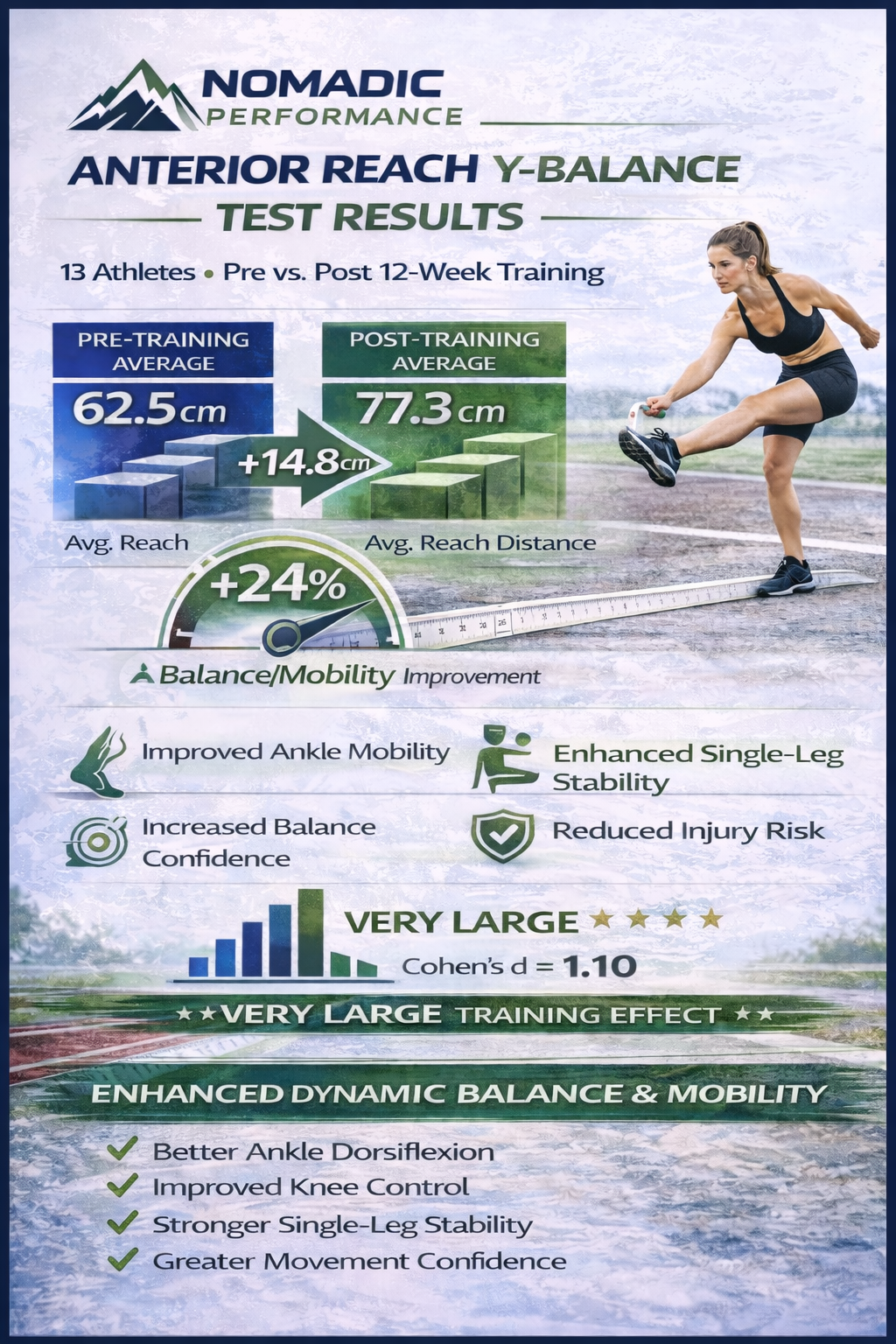
| Average Reach Distance | 62.5 cm | 77.3 cm |
🚀 Mean Improvement
- ➡️ +14.8 cm increase
- ➡️ +23.7% improvement
This represents a substantial increase in dynamic balance capacity.
Statistical Analysis
- p = 0.0019
- Cohen’s d = 1.10
| Metric | Meaning |
|---|---|
| p < 0.05 | Statistically significant |
| Effect Size = 1.10 | Very Large Training Effect |
There is less than a 0.2% probability that these improvements occurred by chance.
What Actually Improved?
The Y-Balance Test is unique because improvements rarely come from a single factor.
The results suggest meaningful adaptations in:
- ✅ Ankle mobility (especially dorsiflexion)
- ✅ Hip stabilization strength
- ✅ Core control during single-leg loading
- ✅ Motor coordination and proprioception
- ✅ Confidence in end-range positions
Rather than isolated strength gains, athletes developed integrated movement capacity.
Symmetry Findings
Side-to-side differences increased slightly but were not statistically significant.
This pattern is common when athletes rapidly improve reach capacity:
- As mobility expands, small asymmetries become more visible.
- Overall movement ability improves faster than symmetry refinement.
Importantly:
Performance improved dramatically without clinically concerning imbalance.
This indicates healthy adaptation rather than compensation.
Why This Matters for Mountain Athletes
- Absorbing terrain variability while skiing or snowboarding
- Maintaining stability during trail running descents
- Controlling body position while climbing
- Reducing knee stress during single-leg loading
Improved anterior reach suggests athletes can:
- Control their center of mass farther forward
- Maintain alignment under load
- Stabilize efficiently during movement transitions
In practical terms:
Athletes gained control in positions where injuries often occur.
How Testing Improves Coaching
At Nomadic Performance, testing isn’t used simply to validate results — it guides future programming decisions.
This dataset provides important coaching feedback:
- Mobility and stability interventions were effective.
- Training dosage produced large adaptations.
- Athletes tolerated progressive loading well.
As a coach, this allows future programs to evolve toward:
- More reactive balance challenges
- Sport-specific single-leg loading
- Advanced plyometric progressions
- Individual asymmetry targeting
The data doesn’t end the process — it refines it.
Key Takeaways
- ✅ +14.8 cm average improvement
- ✅ +23.7% increase in dynamic balance
- ✅ Highly significant results (p = 0.0019)
- ✅ Very large training effect (d = 1.10)
- ✅ Integrated mobility and stability gains
The Nomadic Performance Philosophy
Performance is not built through random workouts.
It is built through intentional assessment and continuous refinement.
Every athlete cycle follows a simple framework:
Assess → Train → Analyze → Refine → Perform
Testing allows training to evolve — and coaching to improve alongside the athlete.
Final Thoughts
Dynamic balance sits at the intersection of mobility, strength, and control.
When athletes improve this quality, they don’t just move farther — they move better.
The results of this case study demonstrate that targeted, evidence-based training can meaningfully enhance stability, mobility, and confidence in single-leg positions.
Because performance isn’t just about power.
It’s about control.
Move Free. Thrive Wild.