Introduction: Why Single-Leg Power Matters
Most athletic movements don’t happen symmetrically.
Ski turns, trail running strides, climbing moves, cutting, landing, and terrain adjustments all occur one leg at a time. Because of this, unilateral power and stability are critical components of both performance and injury resilience.
At Nomadic Performance, one of our primary field assessments for unilateral athletic capacity is the Single Leg Triple Hop Test — a validated measure commonly used in return-to-sport testing and performance evaluation.
This case study examines how a structured 12-week training program influenced single-leg power outcomes across a group of athletes.
Study Overview
- Participants: 13 athletes
- Training Duration: 12 weeks
- Primary Outcome Measure: Single Leg Triple Hop Distance (inches)
Athletes completed standardized testing before and after completing the Nomadic Performance training program.
Testing Method
- Three consecutive forward hops on a single leg
- Controlled landing after the third hop
- Separate testing for left and right limbs
- Best successful attempt recorded
Distances were measured in inches and averaged between limbs for statistical analysis.
Results
📊 Group Performance
| Metric | Pre-Training | Post-Training |
|---|---|---|
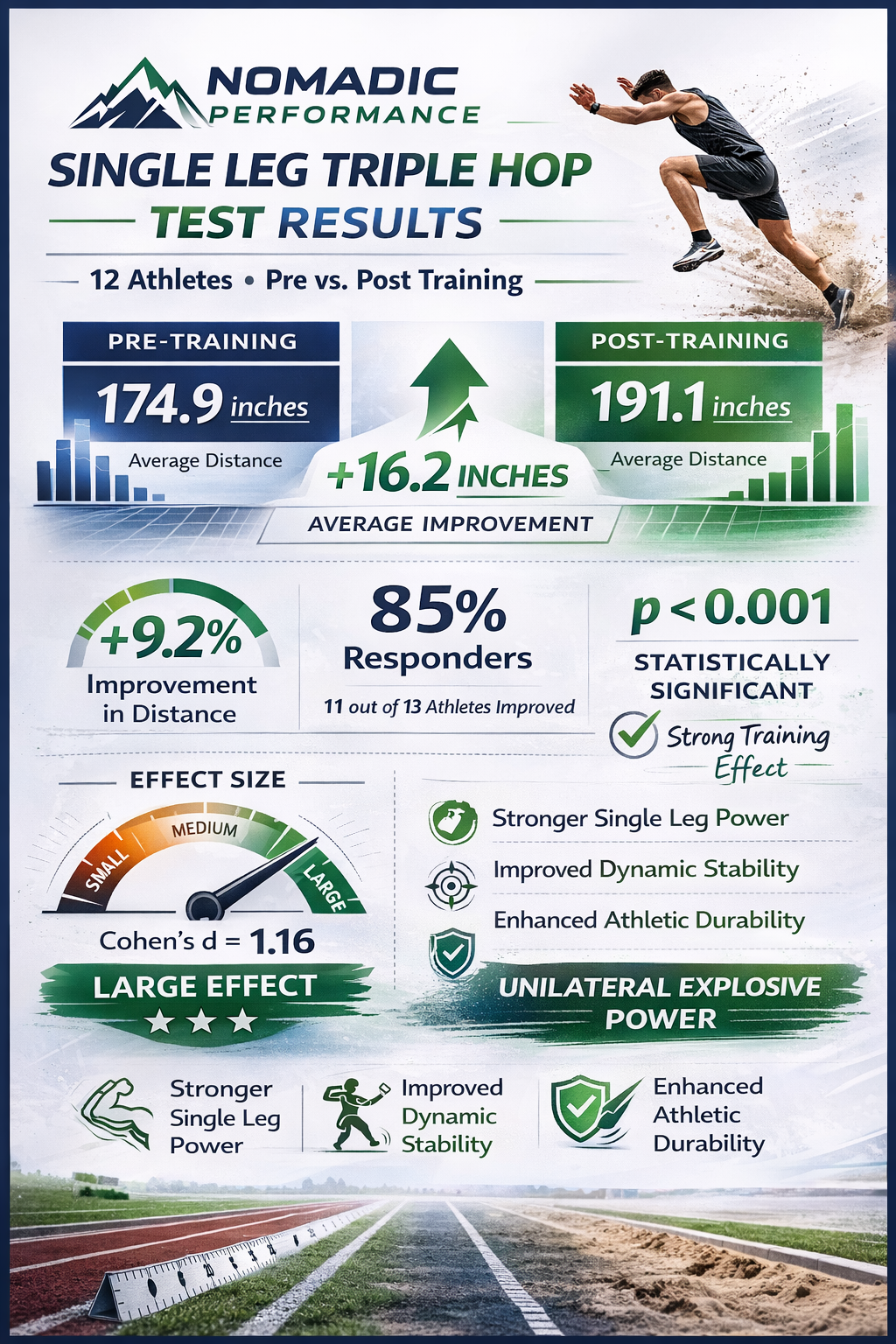
| Average Distance | 174.9 in | 191.1 in |
Average Improvement: ➡️ +16.2 inches
📈 Performance Change
- 9.2% average improvement
- 85% of athletes improved performance
- Improvements observed across both dominant and non-dominant limbs
Statistical Analysis
- p = 0.001
- Cohen’s d = 1.16
| Effect Size | Meaning |
|---|---|
| 0.2 | Small |
| 0.5 | Medium |
| 0.8 | Large |
| 1.16 | Large Training Effect |
These findings indicate the improvements were statistically significant and represent meaningful athletic adaptation.
Why the Triple Hop Matters
The Single Leg Triple Hop evaluates more than just power.
It reflects:
- ✅ Force production
- ✅ Dynamic balance
- ✅ Neuromuscular coordination
- ✅ Limb symmetry
- ✅ Elastic energy utilization
- ✅ Landing control
Improvements in this test suggest athletes developed better force transfer and movement efficiency, not just strength.
Training Principles Behind the Improvements
The Nomadic Performance model emphasizes progressive adaptation rather than random intensity.
- Stability Before Power
Athletes first developed single-leg control and joint stability. - Strength Development
Foundational strength training improved force generation capacity. - Elastic Power Progression
Plyometrics were introduced progressively to enhance reactive ability. - Movement Quality Integration
Athletes trained across multiple planes of motion to reduce compensatory patterns.
Performance Implications for Mountain Athletes
- More efficient ski and snowboard turns
- Better landing mechanics
- Increased trail running propulsion
- Enhanced climbing push-offs
- Reduced asymmetry-related injury risk
In other words:
Better single-leg power equals better movement durability.
Relationship to Other Performance Improvements
| Test | Average Improvement | Effect Size |
|---|---|---|
| Broad Jump | +14.2 in | 1.93 |
| Triple Hop | +16.2 in | 1.16 |
This combination shows improvements in both:
- Bilateral explosive power
- Unilateral athletic control
A hallmark of well-balanced performance development.
The Nomadic Performance Approach
Many training programs measure effort.
We measure adaptation.
Every athlete follows a repeatable system:
Assess → Train → Reassess → Progress
Objective testing ensures training decisions are guided by real performance outcomes.
Key Takeaways
- ✅ Average improvement: +16.2 inches
- ✅ Performance increase: +9.2%
- ✅ Improvement rate: 85% of athletes
- ✅ Statistical significance: p = 0.001
- ✅ Effect size: Large (d = 1.16)
What This Means for You
If you want to improve performance, reduce injury risk, and move with more confidence in demanding environments, unilateral strength and power cannot be ignored.
The first step is understanding your baseline.
Final Thoughts
Performance isn’t built through guesswork.
When training is structured, progressive, and measured objectively, athletes don’t just feel better — they become measurably more capable.
At Nomadic Performance, our mission is simple:
Help athletes move freely, perform confidently, and explore longer.