
Introduction: The Overlooked Plane of Performance
Most athletes train forward.
They squat. They deadlift. They run. They jump.
But mountain sports don’t just demand forward strength — they demand lateral control and endurance under fatigue.
Every ski turn, snowboard edge set, trail landing, or uneven terrain adjustment requires strong frontal plane stability.
To assess this, we use the 30-Second Lateral Step Down Test — a simple but powerful measure of:
- Hip abductor strength
- Knee control
- Frontal plane endurance
- Dynamic valgus resistance
- Neuromuscular coordination under fatigue
This case study analyzes how a structured 12-week Nomadic Performance training program influenced these qualities.
Study Overview
- Participants: 7 athletes
- Training Duration: 12 weeks
- Primary Outcome Measure: Lateral Step Down repetitions (30 seconds)
Athletes performed as many controlled repetitions as possible in 30 seconds, bilaterally. Left and right averages were used for statistical analysis.
Results
📊 Group Performance
| Metric | Pre-Training | Post-Training |
|---|---|---|
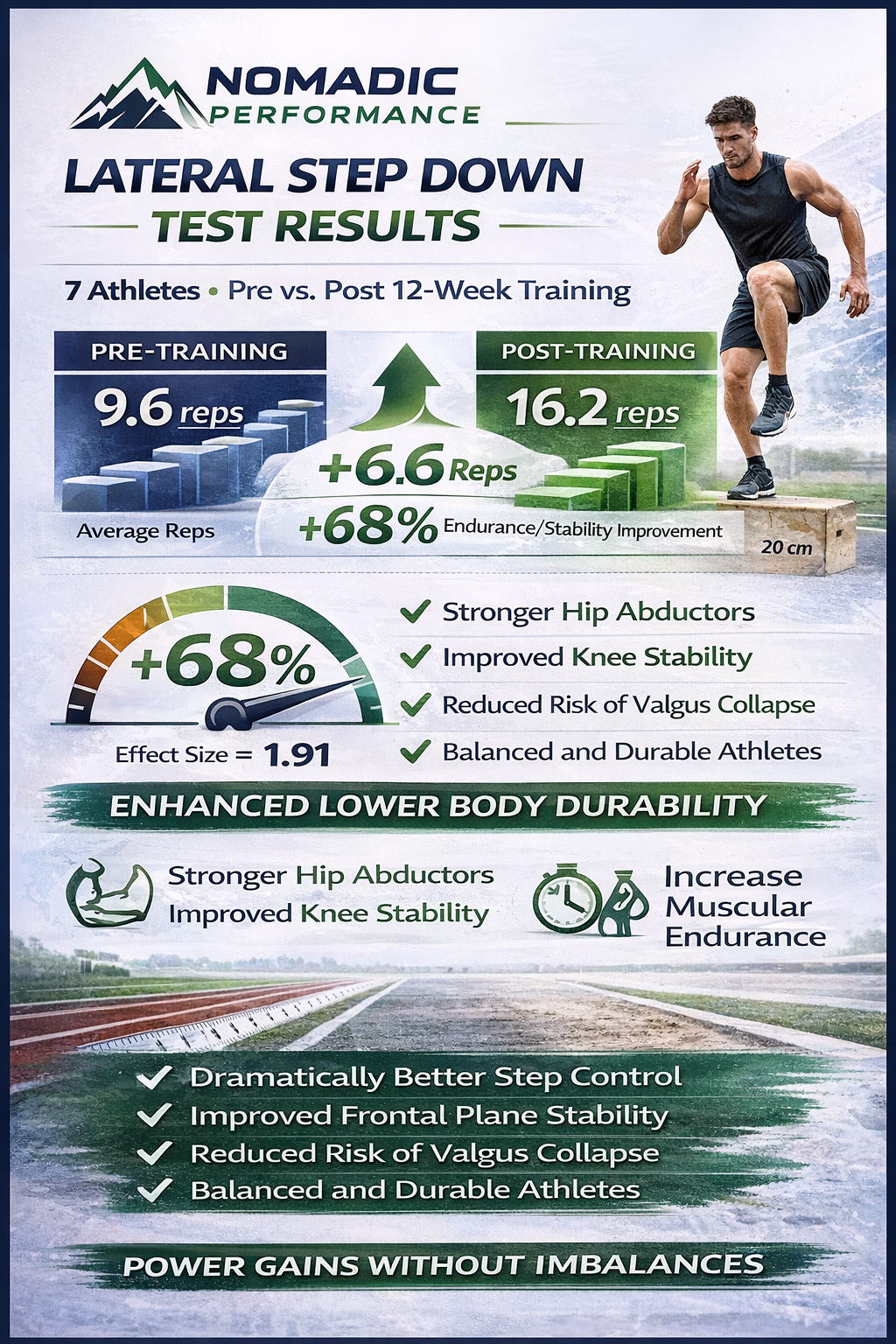
| Average Reps | 9.6 | 16.2 |
🚀 Mean Improvement
- ➡️ +6.6 repetitions
- ➡️ +68% average increase
For a 30-second endurance test, this represents a dramatic improvement in muscular capacity and stability.
Statistical Analysis
- p = 0.002
- Cohen’s d = 1.91
| Effect Size | Meaning |
|---|---|
| 0.2 | Small |
| 0.5 | Medium |
| 0.8 | Large |
| 1.91 | Extremely Large |
This indicates a very strong training effect.
There is less than a 0.3% probability that this improvement occurred by chance.
What This Test Actually Measures
The Lateral Step Down Test evaluates more than just repetition count.
It reflects:
- ✅ Gluteus medius endurance
- ✅ Frontal plane knee stability
- ✅ Resistance to dynamic valgus
- ✅ Motor control under fatigue
- ✅ Lower body durability
Injury research consistently shows that poor frontal plane control is associated with:
- Patellofemoral pain
- ACL injury risk
- IT band syndrome
- Medial knee stress
- Overuse injuries in runners and skiers
Improving this metric directly enhances movement resilience.
Symmetry Analysis
We also examined limb symmetry.
Pre-training average asymmetry: 1.29 rep difference
Post-training average asymmetry: 1.00 rep difference
- No significant increase in asymmetry
- Symmetry maintained while capacity improved
This is critical.
The athletes didn’t just get stronger — they got stronger without developing imbalance.
Why These Results Matter for Mountain Athletes
- Ski turn control
- Snowboard edge stability
- Trail running on uneven terrain
- Cutting and directional changes
- Landing mechanics
Improving lateral endurance by 68% means:
- Greater fatigue resistance
- Better knee tracking under load
- Reduced valgus collapse risk
- Improved durability late in activity
In real-world terms:
Athletes can hold strong positions longer without breakdown.
Programming Implications
These results validate several core principles in the Nomadic Performance model:
- Targeted Frontal Plane Training Works
Lateral strength is trainable and responsive. - Endurance Under Fatigue Is Critical
Capacity improvements likely improve injury resilience. - Symmetry Can Be Preserved During Progression
Performance gains do not have to come at the expense of balance.
How This Data Improves Future Programming
Testing isn’t just about proving results — it’s about refining future training cycles.
This dataset confirms:
- Current loading progressions were appropriate
- Volume and intensity created meaningful adaptation
- The program successfully improved endurance without increasing asymmetry
Moving forward, this allows for:
- Higher-level plyometric progressions
- Increased reactive frontal plane drills
- More sport-specific lateral loading
- Individualized asymmetry targeting when needed
Each dataset sharpens the coaching process.
Key Takeaways
- ✅ +6.6 reps average improvement
- ✅ +68% increase in capacity
- ✅ Statistically significant (p = 0.002)
- ✅ Extremely large effect size (d = 1.91)
- ✅ Symmetry maintained
The Nomadic Performance Philosophy
Durability isn’t built accidentally.
It’s measured, trained, evaluated, and refined.
At Nomadic Performance, we use objective testing to ensure athletes don’t just feel better — they become measurably more resilient.
Assess → Train → Analyze → Refine → Perform
Because better data creates better athletes.
Final Thoughts
Most injuries don’t happen because athletes are weak in the sagittal plane.
They happen when fatigue meets poor frontal plane control.
By dramatically improving lateral endurance and stability, this program enhanced one of the most undertrained — and most important — components of athletic performance.
Stronger. More stable. More durable.
That’s the goal.