Introduction: Strength Isn’t Just About Power
When athletes think about performance, they often focus on strength numbers or explosive power.
But long before power fails, stability fails.
In mountain sports — skiing, snowboarding, trail running, climbing, and cycling — performance depends heavily on the ability to maintain pelvic and trunk control under fatigue. Loss of lateral stability often leads to compensations that increase stress on the knees, hips, and lower back.
To evaluate this quality, we used the Side Plank with Hip Abduction Test, a performance assessment that measures lateral core endurance and hip stability simultaneously.
This case study examines how a structured 12-week Nomadic Performance training program influenced these critical durability markers.
Why the Side Plank with Hip Abduction Test?
This assessment challenges multiple systems at once:
- Lateral core endurance
- Hip abductor strength
- Pelvic control
- Anti-rotation stability
- Neuromuscular coordination
Unlike traditional core tests, this movement reflects real athletic demands — maintaining alignment while the limbs move independently.
In many ways, it represents how well the body stabilizes itself during movement, not just how strong it is in isolation.
Study Overview
- Participants: 13 athletes
- Training Duration: 12 weeks
- Assessment: 30-Second Side Plank with Hip Abduction (bilateral)
Athletes performed as many controlled repetitions as possible within 30 seconds on each side. Left and right values were averaged for analysis.
Results
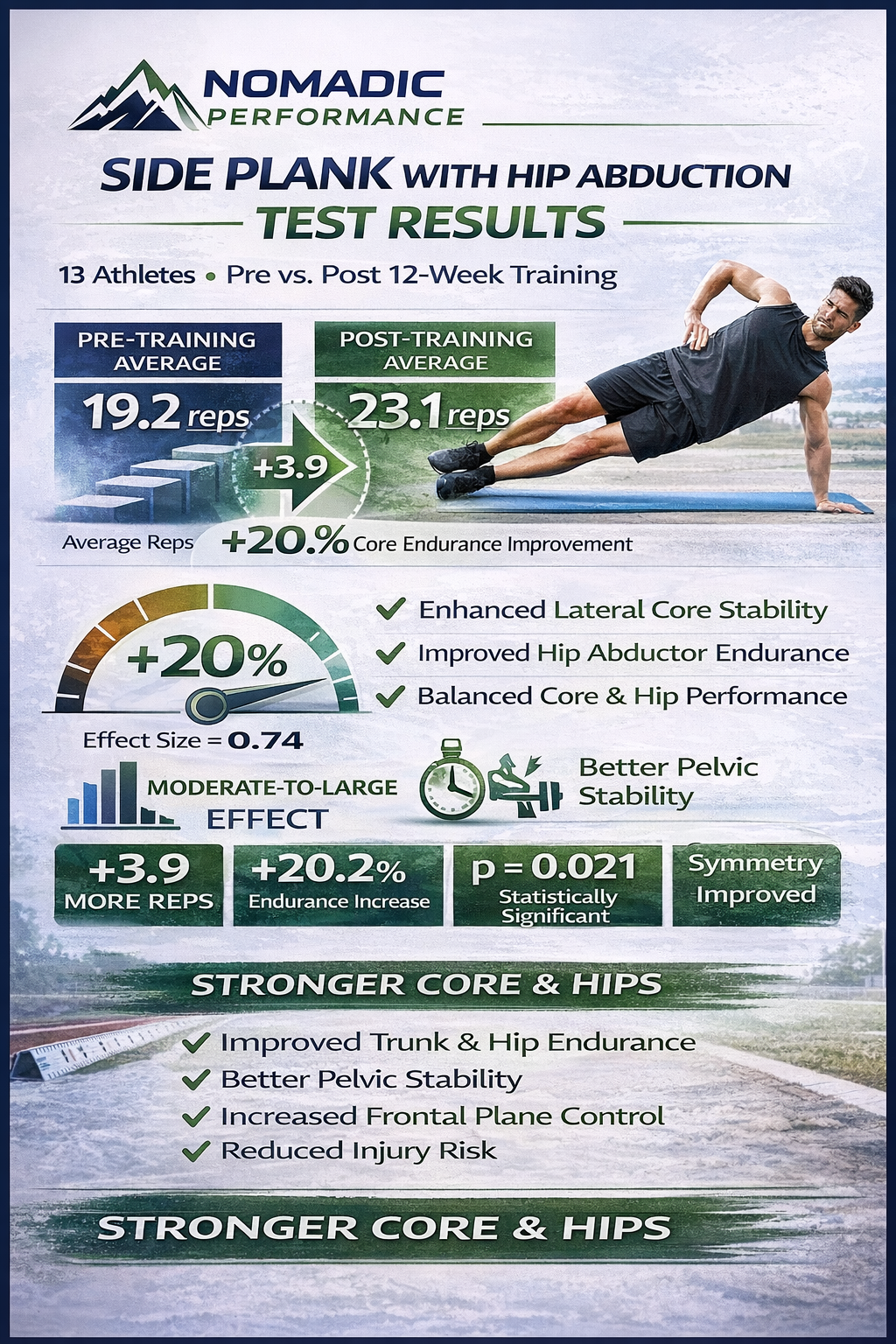
📊 Group Performance
| Metric | Pre-Training | Post-Training |
|---|---|---|
| Average Repetitions | 19.2 reps | 23.1 reps |
🚀 Mean Improvement
- ➡️ +3.9 repetitions
- ➡️ +20.2% improvement
This represents a meaningful increase in lateral core and hip endurance capacity.
Statistical Analysis
- p = 0.021
- Cohen’s d = 0.74
| Metric | Meaning |
|---|---|
| p < 0.05 | Statistically significant |
| Effect Size 0.74 | Moderate-to-Large training effect |
There is only about a 2% probability that these improvements occurred by chance.
What Improved Physiologically?
The results suggest meaningful adaptations in:
- ✅ Gluteus medius endurance
- ✅ Lateral trunk stabilization
- ✅ Pelvic control under fatigue
- ✅ Frontal plane stability
- ✅ Core-to-hip force transfer
These adaptations are especially important for athletes performing repeated unilateral loading — such as carving turns, landing uneven terrain, or stabilizing during long endurance efforts.
Symmetry Findings
An additional goal was maintaining balanced development between sides.
Average asymmetry decreased:
- Pre-training: 2.23 rep difference
- Post-training: 1.54 rep difference
While not statistically significant, the trend indicates improved balance alongside performance gains.
This is important because:
Increased capacity without increased asymmetry reflects healthy adaptation.
Athletes became stronger and more stable without creating compensatory imbalances.
Why This Matters for Mountain Athletes
Fatigue-related instability is one of the most common contributors to injury late in activity.
When lateral core endurance declines:
- Knees collapse inward
- Pelvic control decreases
- Lumbar stress increases
- Movement efficiency drops
Improving side plank performance directly supports:
- Ski edge control
- Snowboard stability
- Trail running mechanics
- Climbing body positioning
- Injury resilience during long sessions
In practical terms:
Athletes can maintain quality movement longer before fatigue causes breakdown.
How Testing Improves Coaching
The purpose of testing isn’t simply to show improvement — it’s to refine future programming.
This dataset provides valuable coaching insight:
- Core endurance responds well to targeted loading
- Training volume was sufficient to drive adaptation
- Progressions improved stability without sacrificing symmetry
As a coach, this helps guide the next evolution of programming.
Future cycles can now include:
- More advanced anti-rotation challenges
- Dynamic lateral stability drills
- Reactive trunk stabilization work
- Individualized asymmetry targeting
Every testing cycle improves not only athlete performance — but coaching precision.
Key Takeaways
- ✅ +3.9 rep average improvement
- ✅ +20% increase in endurance capacity
- ✅ Statistically significant improvement (p = 0.021)
- ✅ Moderate-to-large training effect
- ✅ Symmetry improved alongside performance
The Nomadic Performance Philosophy
Performance isn’t built through random workouts.
It’s developed through intentional training guided by objective data.
At Nomadic Performance, we follow a simple framework:
Assess → Train → Analyze → Refine → Perform
Each assessment informs the next training phase — creating athletes who are not just stronger, but more durable and resilient.
Final Thoughts
Power may define peak performance, but stability determines longevity.
By improving lateral core and hip endurance, athletes develop the foundation needed to move efficiently, resist fatigue, and reduce injury risk across demanding environments.
Because the goal isn’t just to perform better today.
It’s to keep moving freely for years to come.
Move Free. Thrive Wild.