
Introduction: Why Explosive Power Matters
For mountain athletes — skiers, snowboarders, climbers, and trail athletes — performance isn’t just about endurance. Success on the mountain depends heavily on power production and force absorption.
Every turn, landing, terrain transition, and rapid adjustment requires the body to generate and control force efficiently.
One of the simplest and most validated field measures of lower-body explosive power is the Broad Jump.
At Nomadic Performance, we use the Broad Jump to assess:
- Horizontal force production
- Neuromuscular coordination
- Athletic readiness
- Performance adaptation over time
This case study examines how a structured 12-week training program influenced explosive power outcomes in a group of athletes.
Study Overview
- Participants: 13 athletes
- Training Duration: 12 weeks
- Primary Outcome Measure: Standing Broad Jump (inches)
Athletes completed standardized pre- and post-testing using identical testing procedures.
Testing Method
- Multiple jump attempts
- Two-foot horizontal takeoff
- Controlled landing requirement
- Best jump recorded for analysis
Testing conditions were standardized to ensure reliable comparison.
Results
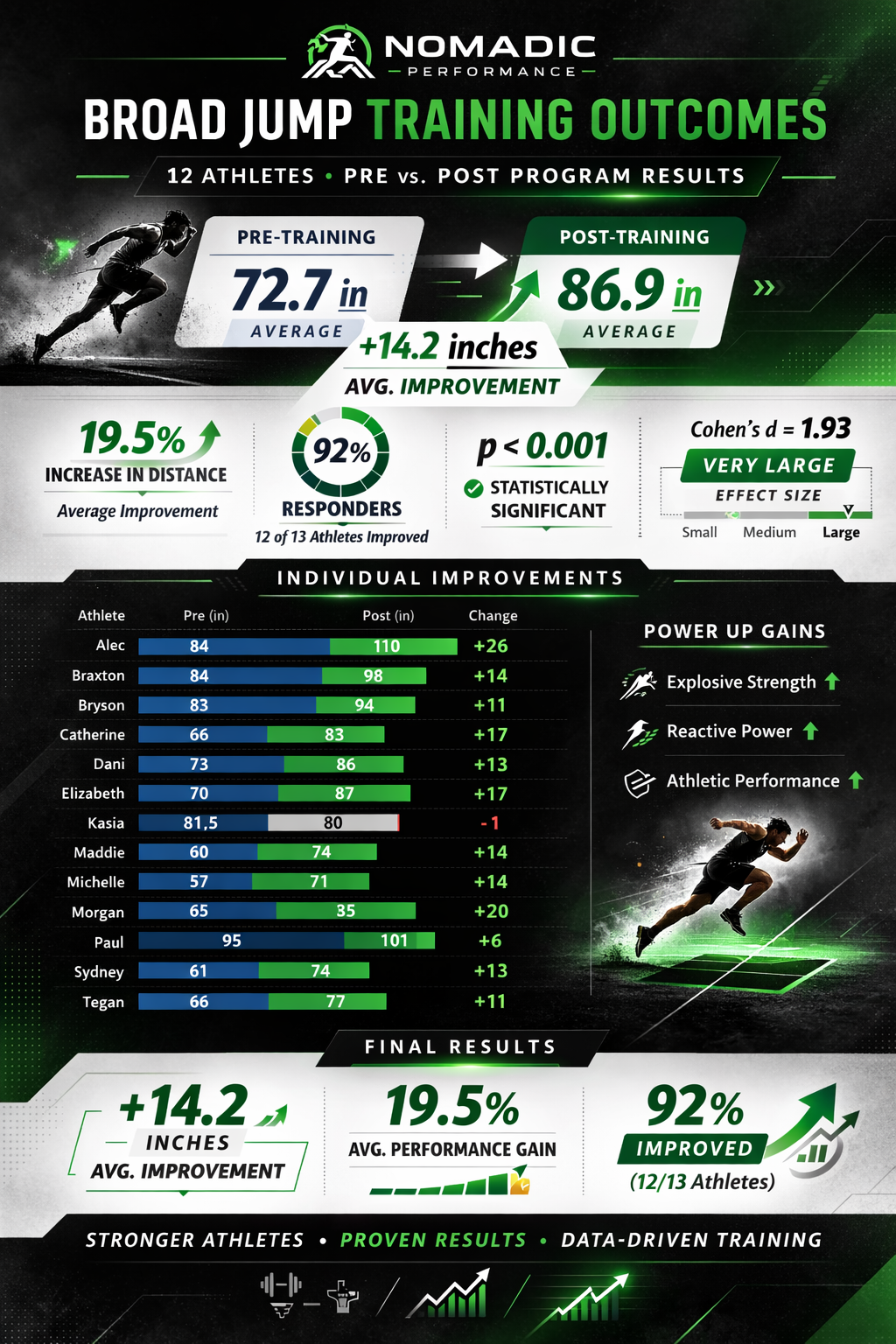
📊 Group Averages
| Metric | Pre-Training | Post-Training |
|---|---|---|
| Average Broad Jump | 72.7 in | 86.9 in |
Average Improvement: ➡️ +14.2 inches
📈 Performance Change
- 19.5% average increase in jump distance
- 92% of athletes improved (12 out of 13 participants)
- Only one athlete demonstrated a minimal change (-1 inch)
Statistical Analysis
- p < 0.001 (statistically significant improvement)
- Cohen’s d = 1.93
| Effect Size | Interpretation |
|---|---|
| 0.2 | Small |
| 0.5 | Medium |
| 0.8 | Large |
| 1.93 | Very Large |
This indicates the improvements were not random variation — but a meaningful adaptation to training.
Why Did Performance Improve?
The Nomadic Performance training model emphasizes three key pillars:
- Strength Before Power
Athletes developed foundational strength to support force production. - Unilateral Stability
Reducing asymmetries improved force transfer efficiency. - Progressive Plyometrics
Athletes trained elastic energy utilization and landing mechanics.
Rather than chasing intensity early, the program built durability first — allowing power to emerge safely.
What This Means for Mountain Athletes
- Stronger ski turns
- Better terrain absorption
- Faster directional changes
- Reduced fatigue accumulation
- Improved injury resilience
Power is not just performance — it is protection.
The Nomadic Performance Philosophy
Many training programs focus only on workouts.
Nomadic Performance focuses on measurable adaptation.
Every athlete follows a cycle:
Assess → Train → Measure → Improve
Objective testing ensures progress is real, trackable, and individualized.
Key Takeaways
- ✅ Average improvement: +14.2 inches
- ✅ Performance gain: +19.5%
- ✅ Improvement rate: 92% of athletes
- ✅ Statistical significance: p < 0.001
- ✅ Effect size: Very Large (d = 1.93)
What’s Next?
If you want to understand your own performance profile, start with the same assessment used in this case study:
Check Out the Ski & Snowboard Readiness AssessmentFinal Thoughts
Performance isn’t guesswork.
When training is structured, measurable, and evidence-based, athletes don’t just feel stronger — they become objectively more capable.
At Nomadic Performance, our goal is simple:
Help athletes move better, perform longer, and explore without limits.